Most visitors to South Africa dream of seeing the Big Five, along with a generous smattering of giraffe and zebra. And rightly so. There’s nothing quite like watching a leopard guarding its kill in a tree or a herd of elephants drinking at a waterhole.
But some of the more interesting safari sightings involve animals you’ve probably never even heard of. An aardvark emerging from its burrow at dusk. A beautifully marked caracal slipping through the undergrowth. Or a family of bat-eared foxes, with ears that seem almost comically oversized.
These lesser-known creatures don’t often feature on safari wish lists. Yet they can cause even the most experienced guides to get noticeably excited.
In fact, at Tswalu Kalahari Reserve, there’s a whole alternative wildlife wish list known as the Elusive Five: aardvark, aardwolf, bat-eared fox, brown hyena, and pangolin. All fascinating animals, and most notoriously difficult to find.
So here we’re celebrating nine of our favorite lesser-known safari animals, with a special mention for the increasingly threatened pangolin. We’ll explain what makes them interesting, where you’re most likely to see them in South Africa, and why sometimes the smallest or shyest animal can be the highlight of your safari.
Which unusual animals can you see on safari in South Africa?
Sightings of wild animals are never guaranteed. These are broad indications of relative likelihood, not statistical probabilities, and can vary considerably between reserves.
1) The Aardvark
Where to see aardvarks in South Africa: Tswalu Kalahari Reserve
The aardvark gets its name from a South African word meaning “earth pig.” The Aardvark is very easily recognizable as it sports a long thinnish nose, which helps to sniff out food, and a tapered tail.
I’ve actually only seen one in my life at Kwandwe Game Reserve, and it was a remarkable creature.
Although aardvarks are found across much of South Africa, they are notoriously difficult to actually see. The sandy terrain of the southern Kalahari Desert is one of the more promising places to look, particularly at Tswalu. Here experienced guides and trackers search for signs of aardvark activity: usually the tell-tale aardvark burrow holes.
Mainly a nocturnal mammal and very shy by nature, you’d typically see the aardvark on night drives when on safari. A nocturnal feeder, it subsists on ants and termites, which it will dig out of their hills using its sharp claws and powerful legs. It also digs to create burrows in which to live and rear its young.
In the cooler winter months, aardvarks sometimes emerge earlier in the afternoon rather than waiting until well after dark. This can create opportunities for sightings in daylight, although they remain far from guaranteed.
Stats in Brief:
Life span: 18-23 yrs Top speed: 38-42 km/h Weight: 60-80 kg Height: 60 cm Length: 105-130 cm
Other Possibilities
Kwandwe in the Eastern Cape and selected Karoo reserves. But we would particularly recommend Tswalu to anyone with a serious interest in finding an aardvark.
Pilanesberg National Park
Tankwa Karoo National Park
Kwandwe Game Reserve, Great Karoo of Eastern Cape
Tswalu Game Reserve, Kalahari Desert of South Africa
Lodges
Motse Lodge, Tswalu Game Reserve, Kalahari of the Northern Cape
Ecca Lodge and their other lodges in Kwandwe Game Reserve, Karoo area of Eastern Cape
2) The Aardwolf
Where to see aardwolf in South Africa: Tswalu Kalahari Reserve
The aardwolf is the lesser-known cousin of the striped and spotted hyenas. Because it’s shy, elusive, and nocturnal, it’s rarely encountered by people. The name aardwolf essentially means earth wolf in the Afrikaans and Dutch languages, but this is misleading because it’s not a wolf at all.
Don’t be afraid of its ferocious growl since this only a mechanism to scare away other predators. Unlike many of its predator relatives, the aardwolf does not hunt large animals. It eats insects and their larvae, mainly termites.
Aardwolves favour open grasslands and semi-arid country where their preferred termites are abundant. Tswalu is one of the best-known safari destinations for tracking them.
Kwandwe in the Eastern Cape is another good possibility, with suitable open grassland habitat.
However, aardwolf sightings are exceptionally unpredictable. To be brutally honest, aardwolf sightings are very rare. I’ve only seen one in my life and the rangers were ecstatic about seeing it.
Even experienced guides may go years between encounters, which makes finding one particularly exciting.
Stats in Brief:
Life span: 8-20 yrs Weight: 7-10 kg Height: 40-50 cm Length: 55-80 cm Habitat: Open, dry plains and bushland, avoiding mountainous areas.
Other Possibilities
Great Fish River Lodge, Ecca Lodge and their exclusive use villas in Kwandwe Game Reserve, Karoo area of Eastern Cape
Motse Lodge, Tswalu Game Reserve, Kalahari of the Northern Cape
3) The Bat-Eared Fox
Where to see bat-eared foxes in South Africa: Kgalagadi Transfrontier Park
It’s a species of fox with unusual huge ears, much out of proportion with the rest of its body. . They dig dens in which to raise their young that also provide shelter from extreme temperatures and high winds.
Bat-eared foxes particularly like the open, semi-arid landscapes of the Kalahari. They are more readily encountered than most of the other members of Tswalu’s Elusive Five and can sometimes be seen foraging in family parties during daylight hours. They are highly social so if you spot one, keep your eye out for more.
They tend to hunt in short grass and low shrub habitats but will sometimes venture into areas with tall grasses and thick shrubs to hide when threatened.
The Kgalagadi Transfrontier Park is an excellent option for travellers enjoying a self-drive wildlife holiday, while Tswalu offers an exclusive privately guided experience.
Stats in Brief:
Population size: Unknown Life span: 6-13 yrs Weight: 2-4.5 kg Length: 46-66 cm Habitat: Bat-eared Foxes can be found in the southern part of Africa from Cape Peninsula and Cape Agulhas in South Africa to Angola and Zambia.
Other Possibilities
In contrast to the aardwolf, the bat-eared fox is the one animal that you may well see on safari, especially in the Western Cape & Karoo game reserves
Sanbona Game Reserve
Tankwa-Karoo National Park
Namaqua National Park
Gondwana Game Reserve
Lodges
Any of the rest-camps in the Kgalagadi National Park
Motse Lodge, Tswalu Game Reserve, Kalahari in Northern Cape
Kwena Lodge, Gondwana Game Reserve, Garden Route
4) The Black-Backed Jackal
Where to see black-back jackals in South Africa: Greater Kruger & Kgalagadi Transfrontier Park
Black-backed jackals are among the more frequently encountered animals on this list. They occur in a wide range of South African reserves, so there is usually no reason to design a safari specifically around seeing one.
They are known for their cunning and daring. They are often seen nipping in to steal a morsel from lions, or hyena, on a kill. Mainly nocturnal but seen regularly during the day, this handsome animal has a call to remember
In the Kgalagadi, jackals are also regularly encountered in the open landscapes, where their behaviour can be particularly rewarding to observe.
(I have fond memories of self-identifying plenty of black-backed jackals on my first “self-drive” safari in the Kalagadi Transfrontier Park way back in 1995. )
The Black-backed Jackal feeds on small mammals, reptiles, birds, eggs, carrion, and fruit. From a farmer’s point of view, they would be regarded as pests, since they would hunt in packs to potentially catch smaller livestock, such as sheep.
We don’t recommend a particular lodge solely for jackal sightings. They are one of the enjoyable extras on a well-planned safari.
Stats in Brief:
Life span: 8-14 yrs Weight: 6-13 kg Height: 38-48 cm Length: 67-81 cm Top Speed: 32 km/h Habitat: The Black-backed jackals can be found in diverse habitats, living in coastal areas, deserts, and mountains. They prefer dry areas, avoiding wetlands and swamps.
A pair of black-backed jackals (Canis mesomelas) eating a dove, Kalahari desert, South Africa.
5) Brown Hyena
Where to see brown hyena in South Africa: Welgevonden Game Reserve or Tswalu
This rare, woolly creature is certainly one to look out for when you are visiting the drier areas of Southern Africa. The Brown Hyena is a carnivore which has adapted to a scavenging lifestyle. It will, however, supplement its diet with insects, birds’ eggs and wild fruits and even occasionally kill small animals.
Interestingly, the brown hyena has also been called the “strandwolf” in Afrikaans, meaning “beach wolf” since it is often spotted in coastal areas.
The southern Kalahari is one of the most important strongholds for brown hyenas, either the Kalagadi Transfrontier park, or Tswalu.
At Tswalu, experienced guides and trackers can search for brown hyenas, although sightings remain unpredictable.
The most interesting encounter that I’ve had is when a brown hyena chased a leopard off the remains of a kill and up into a tree. I had no idea it would take on a predator of that size.
Stats in Brief:
Population size: 5,000-8,000 Life span: 12-13 yrs Weight: 38-44 kg Height: 70-80 cm Length: 130-160 cm Habitat: The south part of the Kalahari Desert is the location of the largest population in existence today. These animals inhabit semi-desert and desert areas, open woodland savanna, and open scrub.
Other possibilities to see brown hyena in their natural habitat in Southern Africa?
Welgevonden Private Game Reserve in the Waterberg.
Central Kalahari Game Reserve, Botswana
Mountain Zebra National Park, Eastern Cape
Kwandwe Private Game Reserve, Eastern Cape
Lodges
Dinaka Camp near Central Kalahari Game Reserve, Botswana
Our first choices: The Karoo and selected Eastern Cape reserves.
The Afrikaans name for the caracal is “rooikat” (‘red cat”) and this is the most apt name given its reddish fur. The caracal is a mostly nocturnal, secretive, solitary and an aggressive animal. The caracal is a carnivore that typically preys upon small mammals, birds, and rodents.
Caracals occur across a surprisingly wide range of South African landscapes, from the dry Karoo to the Cape’s fynbos-covered mountains and the savannas of the north.
For safari travellers, we would concentrate on the open landscapes of the Karoo and Eastern Cape, where there may be better opportunities to spot one moving through the bush or crossing a track.
De Hoop Nature Reserve is another possibility if you are exploring the Western Cape, while caracals also occur in Greater Kruger and Addo Elephant National Park.
Nevertheless, caracals are elusive almost everywhere. A sighting is usually a wonderful stroke of luck rather than something you can reliably plan for.
Caracal can be found throughout South Africa and prefers open areas in woodland savanna as well as rocky, hilly areas with the availability of cover.
Stats in Brief:
Population size: Unknown Life span: 12-17 yrs Weight: 8-18 kg Height: 40-50 cm Length: 73-78 cm Habitat: In Africa, the caracal is found everywhere except the central Sahara and the dense forest areas of equatorial West Africa. Caracals inhabit forests, woodlands, savannas, grasslands, semideserts, and scrub forests, but it prefers dry areas with low rainfall
Where to see caracal in their natural habitat in South Africa?
De Hoop Nature Reserve
Kruger National Park
Addo Elephant Park
Hluhluwe Game Reserve
Caracal can be spotted in many game reserves, so you don’t need to restrict yourself. But here are some favourites anyway.
7) The Meerkat
Our first choices: Tswalu Kalahari Reserve and Oudtshoorn.
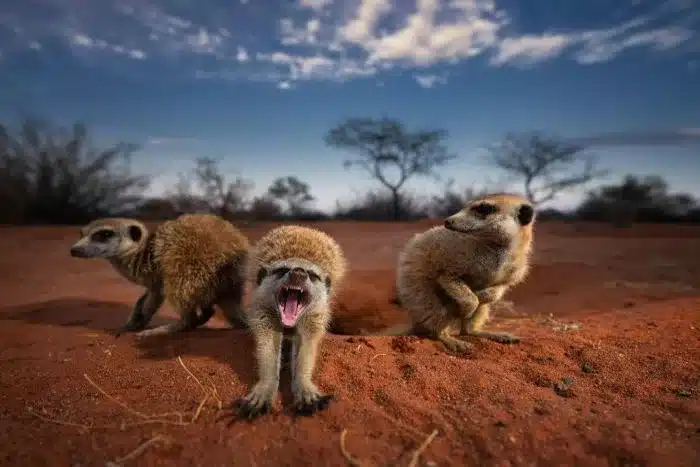
Meerkats live in the deserts and grasslands of the southern tip of Africa. They are extremely cute, with bushy, brown-striped fur, a small, pointed face, and large eyes surrounded by dark patches. But be aware, the cuteness of the meerkat can easily disappear when they feel provoked.
Meerkats have foreclaws adapted for digging and have the ability to thermoregulate to survive in their harsh, dry habitat. These extremely social animals live together in burrows, which they dig with their long, sharp claws.
But these sociable creatures do have to be habituated to seeing humans and so that means that there are relatively FEW places that you are likely to see them.
At Tswalu, guests can spend time watching wild meerkats emerge from their burrows in the early morning. It’s a particularly appealing experience for families and wildlife photographers.
For travellers exploring the Garden Route or Little Karoo, a guided sunrise meerkat experience De Zeekoe Guest Farm (near Oudtshoorn) take visitors to habituated wild colonies.
These experiences must be booked in advance and are weather-dependent. The meerkats are never fed or handled.
Stats in Brief:
Population size: 500,000 Life span: 8-20 yrs Weight: 0.6 to 1 kg Height: 25-30 cm Habitat: The meerkat has a wide distribution in southern Africa, from the extreme southwest of Angola, through Namibia and Botswana, and into the west and north South Africa. They live in areas with
Where to see meerkat in their natural habitat in South Africa?
De Zeekoe Guest Farm offers daily sunrise meerkat tours near Oudtshoorn.
Skeiding Guest farm
Motse Lodge, Tswalu Kalahari Reserve,
Jacks Camp and San Camp, Makgadikgadi Salt Pans, Botswana
Interested in booking a Safari or Holiday?
Chat to one of our experienced consultants that’s here to help and guide you.
We use our expertise to narrow down the choices and present feasible ideas, so you can relax and ENJOY the planning process!
Contact us!
8) The Serval
Where to see serval in South Africa: Suitable grassland and wetland habitats, including parts of Greater Kruger.
Servals differ from many of the other animals on our list because they favour relatively well-watered grasslands, wetlands and reedbeds rather than dry, desert-like environments.
They can be seen in parts of the Greater Kruger and northern KwaZulu-Natal, where sightings are possible on game drives, particularly around dawn, dusk and after dark.
Though they are common, they are shy and elusive, so you tend to see a quick glimpse of them rather than a long sighting. So we would regard a serval encounter as a lucky bonus rather than something to expect.
One interesting alternative is Rietvlei Nature Reserve near Pretoria, which has an established serval population and a documented record of sightings. Although not a conventional luxury safari destination, it illustrates just how strongly servals are associated with suitable grassland habitat.
Stats in Brief:
Population size: Unknown Life span: 8-20 yrs Weight: 9-18 kg Height: 54 to 62 cm Length: 67 and 100 cm
Where to see serval in their natural habitat in South Africa?
The Kruger National Park
Lapalala Game Reserve
Northern KwaZulu Natal reserves
Most of the private game lodges in the Greater Kruger can spot serval on night drives
9) The Pangolin
Where to see pangolin in South Africa:Tswalu Kalahari Reserve.
Temminck’s pangolins occur in parts of South Africa, but they are among the most difficult mammals to encounter in the wild.
I have ever only seen one, in the Sabi Sands Game Reserve of the Kruger.
However Tswalu is particularly well known for tracking these shy, predominantly nocturnal creatures. Specialist guiding and knowledge of their habits can improve the chances of finding one, but sightings remain rare.
For pangolin conservation:Noka Camp at Lapalala Wilderness Reserve.
Another alternative is Noka Camp in the Waterberg region. Here there is the world’s first Pangolarium, established at Lapalala Wilderness Reserve in partnership with the African Pangolin Working Group and funded by Lepogo Lodges.
Rather than offering guaranteed pangolin sightings, this project focuses on the veterinary treatment, rehabilitation and eventual release of pangolins rescued from illegal wildlife trafficking.
It’s a fascinating example of conservation work taking place in a safari destination, and something we feel deserves greater recognition.
Note: Any opportunities for Noka guests to learn about the project should be confirmed in advance, with the welfare of the pangolins taking priority.
How to increase your chances of seeing unusual wildlife
Opt for a private game reserve where night drives after sunset are allowed.
If you really want to see a specific animal, then take note of the terrain where it is most likely to be sound, and also the chances of a sighting (see our table above)
Colder drier weather increases the chances of an encounter for some of these animals. For example, aardvarks may emerge earlier during cold winter weather to feed, making daylight sightings more possible.
Looking for something a little different on safari?
The Big Five may be the headline attraction, but there’s so much more to discover in the African bush.
Whether you’re hoping to track down some of the Kalahari’s Elusive Five, spend a morning with a meerkat colony, or simply enjoy the unexpected encounters that make a safari so rewarding, we can help you choose the right places to go.
At Cedarberg Africa, we’ve spent over 30 years exploring Africa’s safari destinations. We know which reserves are particularly rewarding for different wildlife interests, and we’ll always be candid about what you’re realistically likely to see.
Ready to plan your safari to see some of these incredible and unusual animals?
Share your ideas with us, and we'll craft an itinerary that ticks every box – and maybe includes a pangolin (if you are very lucky!).