Over the last few years there has been an explosion of activity in this once sleepy backwater close to Victoria Falls. There have a raft of new game lodges opening up on the river banks. For years the Zambezi National Park was considered the small, somewhat inconsequential step-sister, to the bigger and brasher Chobe National Park. But, why?
- Chobe had the brand name. Chobe was in Botswana which is far better known than Zimbabwe.
- Chobe offered both land and water activities which is attractive to people wanting to have a varied safari experience. Chobe had safari lodges to suit all pockets (within a Botswana safari context).
But over the years, Chobe has almost become a victim of its own success. It is now very busy in the park. So perhaps the ugly step-sister analogy is too unfair. But people have been starting to look elsewhere. Meanwhile there is no denying that some fairy godmother has turned the Zambezi National Park into a princess. And not just for one night!

Where is the Zambezi National Park?
The Zambezi National Park has a stunning location being between Victoria Falls and the border with Botswana (i.e. en route to the Chobe National Park).
It also borders a river. But this time it’s the mighty Zambezi River (which the smaller Chobe River of Botswana runs into). It is a sizeable park, being 55,000ha. (To put that into perspective, the Sabi Sands adjacent to the Kruger is only 62,000ha). And, although it is not as vast as Chobe, , most Chobe visitors stay in a much smaller area close to the river anyway, because of the limited road network further south.


Wildlife in the Zambezi National Park
And the wildlife is surprisingly good for such a lesser-known park. Although it may not boast as much wildlife diversity, the beauty of being in this park is the ability to get close to game sightings. You are likely to spot buffalo, elephant, lion, and leopard. And of course other wildlife such as kudu, impala, sable, eland, warthog, and zebra.
And let’s not forget the advantage that the mighty Zambezi River brings. You’ll catch a glimpse of crocodile, waterbuck, and many pods of hippo when game viewing close to the banks of the river.


Advantages of Zambezi National Park:
Close to Victoria Falls
Typically it is only 45 to 90 minutes from Victoria Falls to most lodges in the Zambezi National Park. This means that you can visit the Falls from your lodge. This is usually offered as an included activity, especially if you stay for 3 nights. Or you can spend 1 night at the Falls and then continue here for your safari experience. Without losing a precious vacation day to travel.
Much Quieter
It is much quieter compared to the Chobe National Park where you are jostling for sightings with loads of other vehicles. And it is more peaceful than the busy town of Victoria Falls. Here the constant hum of helicopters flying over the Falls can be heard.
Bush Walks and Night Drives
Bush walks are a wonderful way to experience the bush on a whole new level. You won’t just discover the tracks and signs of larger wildlife, but will also learn about smaller creatures, trees and plants… and all with your senses (sight, smell, taste, sound and touch)!
And this park also allows for night drives, an activity that is not on offer in all national parks. This is the perfect way to get a glimpse of nocturnal animals (like the elusive leopard, genet, porcupine, honey badger and giant eagle owl). The big cats tend to be more active at night and you may find yourself following lions on the hunt.
Ultra-luxurious Lodges
Chobe has no ultra-luxurious lodges, because it is a national park and thus you cannot describe it as exclusive. But that’s not the case for the Zambezi where there are several upmarket and uber-deluxe lodges to choose from.
Canoeing
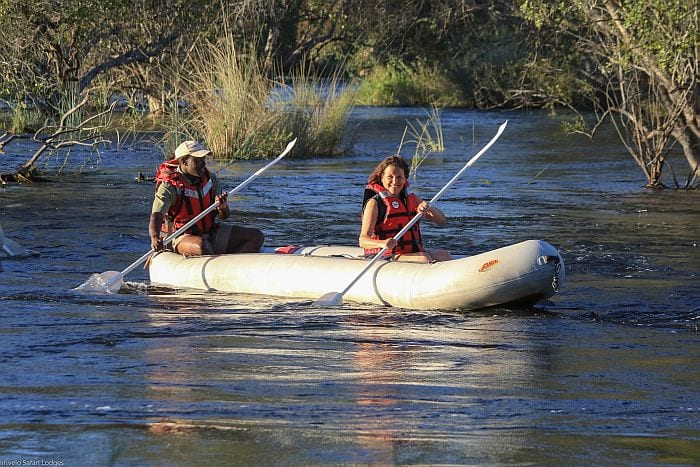
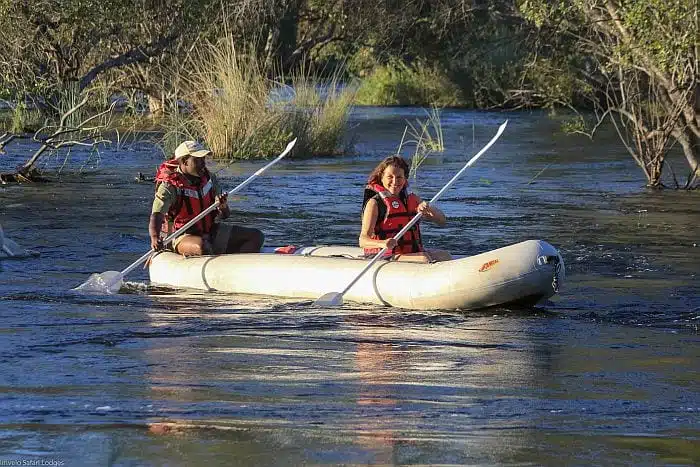
If you like to be active, you’ll enjoy the fact that many of the lodges offer canoeing on the Zambezi River, with its gentle, but nevertheless, exhilarating rapids.
Easy to combine with the Okavango Delta
As the park lies on the route between Victoria Falls and Kasane Airport (for flights into the Okavango), it’s easy to include in a safari itinerary.