Before You Go
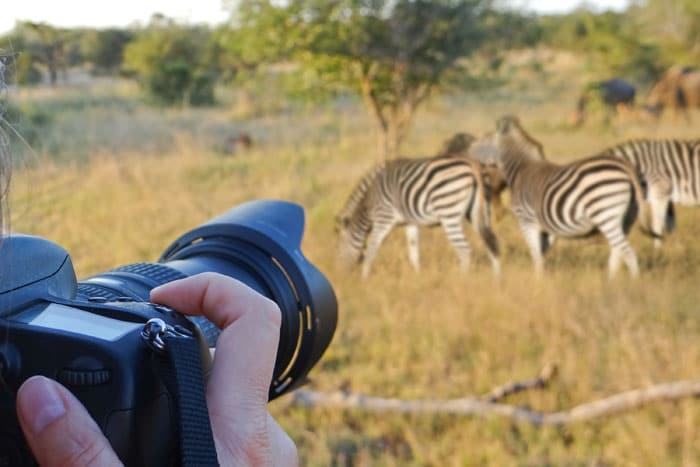
Consider taking two cameras between two of you. One ‘point and shoot’ or one camera with a wide angle lens (18-55 mm), and one camera with its zoom lens already mounted (eg. a 100-400 mm would be ideal). A safari is a bumpy, often dusty, experience and things happen in the blink of an eye. You don’t want to have to change lenses on the go and risk missing the action – more on that in ‘Nature of the Game Drive’. Plus a smaller camera is best on a game walk…
Your camera bag should ideally be big enough (waterproof and dust resistant) to hold your camera with its zoom lens mounted (including hood if possible). So that it’s protected when not in use, but ALWAYS ready to go…
In your camera bag:
Spare memory card or card reader – so that you can download images. You would be amazed how quickly a memory card can get full. You always take more photos on a game drive than you expect. I recommend taking them at maximum resolution. You never know when you will be lucky, or skilled enough, to take that killer shot.
Battery charger and adapter – for the country you are travelling to. Nearly every camp in Southern Africa has some capacity to charge camera batteries. I recommend taking a spare battery as well if most of your safari is in remote areas. Just in case, as power shortages can happen…
Bean bag or monopod – to steady your camera.
Binoculars – not a camera item but worth reminding you about. Preferably one per person but at least one to share between two people. (So for a family of five for example, I recommend at least three pairs.)
If you are a keen photographer – bring a long lens (400 mm upwards). I would also recommend a monopod or a window clamp which can be fixed onto the seat back or vehicle door. The jury is still out on which is better in our Southern African safari context so see ‘Nature of Game Drive’ below.
If it is a new camera, play around with it at home before your safari. Make sure you know how to do the basics. For example how to compensate for low light conditions; how to blur the background to focus on the animal. Ideally, go on a photographic course to familiarize yourself with your equipment and what your equipment is capable of.
If you are a keen photographer, ask your tour operator to request a ranger who is a keen photographer himself. If not a photographer, then at least one that understands the needs of a photographer. This may not always be possible given ranger leave schedules…