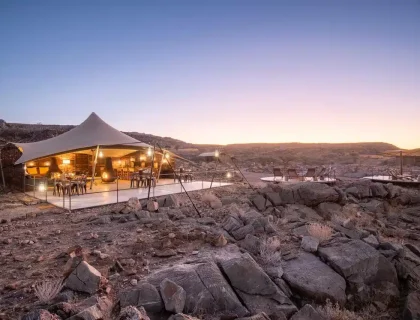
Damaraland

Damaraland’s innate rugged beauty, ancient rock art and the rare chance to encounter desert-adapted elephant and rhino combine to create one of Namibia’s most compelling wilderness regions.

Scroll for more

Damaraland: Where Desert, Stone and Wildlife Collide

Damaraland Highlands Namibia, Spitzkoppe rock formations

We’ll put our cards on the table from the start: Damaraland is one of our favourite regions in Namibia. Not for easy drama or headline wildlife numbers, but because its innate beauty is only intensified by the solitude and the sense of freedom it inspires.

This is a place where vast landscapes and ancient history quietly take centre stage. Add in its wild-roaming wildlife and ancient rock art. And it's a winning mix.

Photographers are drawn to Damaraland for its sculptural geology: towering granite domes, flat-topped mountains and seemingly endless horizons. Dry riverbeds such as the Huab, Ugab and Uniab thread through the wilderness, their hidden underground water sustaining ribbons of green trees in an otherwise austere terrain. These lifelines support wildlife – elephants, rhino, giraffe - that have adapted ingeniously to the desert environment.

Damaraland is a year-round destination, with each season offering a different balance of wildlife, climate and atmosphere.

Damaraland isn’t about ticking boxes. It’s about feeling small in the best possible way — immersed in a landscape that has been shaping life for millennia.

Southern Damaraland: Twyfelfontein & Brandberg

Damaraland safari - Twyfelfontein rock engravingsSouthern Damaraland is dominated by its geology and archaeological treasures. We usually recommend one to two nights here, staying close to Twyfelfontein, a UNESCO-listed site and one of Africa’s most important collections of prehistoric rock engravings.

Nearby, the Petrified Forest, Burnt Mountain and Organ Pipes are all worth a visit. You will need two nights if you want to enjoy a nature/game drive in search of desert-adapted elephant.

Further south you will pass the imposing Brandberg Massif which adds further layers of intrigue to the landscape.

Northern Damaraland – remote wildlife reserves

Damaraland - desert adapted elephantFurther north, the scenery becomes more mountainous and remote. Lodges here focus on slow exploration - soaking up the stark mountain beauty and searching for desert-adapted wildlife, as well as arid-zone species such as gemsbok, springbok and jackal. In 1-2 remote reserves, you may also encounter the elusive western black rhino.

Note: Activities vary considerably by lodge, so your Cedarberg Africa consultant will help match the experience to your interests.

Back to main Namibia safari page

Frequently Asked Questions

How do you explore Damaraland — guided or self-drive?
Damaraland works well for both guided safaris and confident self-drivers, though distances are long and roads are fairly rough.

Damaraland - viewing black rhinoIs Damaraland suitable for families?
Yes, particularly for families with older children or teenagers. The landscape, rock art and wildlife tracking offer an educational and adventurous experience beyond traditional game drives.

How much time should I allow for Damaraland?
You can stay for just 2 nights near the Twyfelfontein area. However we recommend at least three to four nights, ideally split between southern and northern Damaraland, to experience both the archaeological highlights and the more remote wildlife areas.

Let us design a Namibia safari that allows time to truly absorb Damaraland’s landscapes, wildlife and ancient stories.

Links:

Why We Love It

  • Home to Namibia’s remarkable desert-adapted elephant and rhino
  • Opportunity to track desert rhino on foot with expert guides (Desert Rhino Camp)
  • Vast desert and mountain scenery that rewards slow exploration
  • Twyfelfontein’s rock engravings, one of Africa’s great prehistoric art sites
  • The haunting beauty of the Petrified Forest
  • Visits to Himba communities in the northern reaches of Damaraland (nomadic so not guaranteed)
  • Insight into Damara culture at the Damara Living Museum - shows how the Dama people used to live as well as how they live now

When to visit Damaraland

Summer - sporadic rain

Although this is officially Damaraland’s rainy season, rainfall here is typically light and localised. As a semi-arid region, showers tend to arrive as short afternoon thunderstorms, particularly from January to March, leaving plenty of sunshine for much of the day. Daytime temperatures are warm to hot (around 29–31°C). Wildlife disperses more widely at this time as water becomes more readily available, making sightings less predictable. That said, this is when you may see young elephant calves, and it is the best season for birding, with migratory species in residence and landscapes briefly softened by green flushes.
AVG RAINFALL 58mm
MAX TEMP 31 ℃ / 88 ℉
MIN TEMP 17 ℃ / 63 ℉
TALK TO US

Shoulder season - great time to visit

As the summer rains fade, temperatures become more moderate and conditions are noticeably more comfortable, especially by May. The landscape still carries traces of green, while wildlife begins to concentrate again around reliable water sources. This is a rewarding time to visit: quieter than peak season, excellent for photography, and increasingly good for tracking desert-adapted elephants and other wildlife.
AVG RAINFALL 22mm
MAX TEMP 29 ℃ / 84 ℉
MIN TEMP 14 ℃ / 57 ℉
TALK TO US

Dry season - best time to visit

These winter months are traditionally considered the best time to visit Damaraland. The dry conditions make wildlife easier to locate, particularly around pumped waterholes that are essential for animals during this period. Daytime temperatures are mild and pleasant, though early mornings and evenings — especially in June and July — can be surprisingly cold.
AVG RAINFALL 1mm
MAX TEMP 26 ℃ / 79 ℉
MIN TEMP 9.5 ℃ / 49 ℉
TALK TO US

Warming up quickly

Temperatures rise sharply in late September and October, making this the hottest time of year before the summer rains arrive. Make sure you’re comfortable with heat. Game-viewing can still be excellent, with wildlife concentrated near water. Toward November, the first rains usually fall, transforming the scenery and heralding the arrival of migratory birds and the start of the calving season.
AVG RAINFALL 10mm
MAX TEMP 32 ℃ / 90 ℉
MIN TEMP 16 ℃ / 61 ℉
TALK TO US

Download our Insiders Guide to Namibia Safaris

Major Game Reserves, Sample Tours & Camps, plus the low-down on Best Time to Visit! Get our Free Guide here
Find me the best in for
staff image

Leanne Koopman-Monk

AFRICAN TRAVEL SPECIALIST

Hi I'm Leanne, I'm here to help you plan your ideal holiday experience GET IN TOUCH